You bought the acid toner. You added the enzyme mask. You started double-exfoliating on the weekends because your skin felt congested. And now... it looks worse. Redder, tighter, somehow both oily and flaky at the same time. The exfoliation isn't fixing your skin. It's the problem.
Most people who come to us have already cycled through three different cleansers and doubled their routine before considering over-exfoliation as the cause. The problem was never the products. It was the frequency, and what chronic over-exfoliation does to the scaffolding your skin relies on to function.
|
QUICK ANSWER What are the signs of over-exfoliation? The 7 main signs of over-exfoliation are: (1) persistent redness or flushing, (2) tight or stinging skin after cleansing, (3) a shiny, waxy appearance without moisturizer, (4) increased breakouts or milia, (5) sudden sensitivity to products that previously worked, (6) dry patches alongside oily areas, and (7) slow or stalled skin healing. These symptoms indicate a compromised stratum corneum and impaired barrier function, not a need for more exfoliation. Recovery requires a minimum 4–6 week step-down protocol that prioritises ceramide and lipid replenishment. |

The Inflammatory Cascade: What Actually Happens When You Exfoliate Too Much
The stratum corneum (the outermost layer of the skin) is not dead skin. It's a sophisticated lipid matrix: ceramides, cholesterol, and free fatty acids arranged in a precise lamellar structure that regulates transepidermal water loss (TEWL) and shields the dermis from environmental insult.
Strip it repeatedly with acids, enzymes, or physical friction, and you don't reveal fresher skin. You trigger what researchers call a sustained inflammatory response: a loop of cytokine release, barrier disruption, and immune activation. A 2021 paper in the Journal of Investigative Dermatology found that even moderate surfactant-induced barrier disruption significantly increased skin IL-1α levels, a key pro-inflammatory marker. Now multiply that by six exfoliation sessions a week.
The skin doesn't get the recovery window it needs to rebuild its lipid barrier. It compensates with sebum overproduction. You read that as congestion. You exfoliate more. The cycle compounds.
The 7 Signs of Over-Exfoliation (And What Each One Tells You)
1. Persistent Redness or Flushing
Redness that doesn't resolve between sessions signals active inflammation, not normal post-exfoliation turnover. Your skin's inflammatory response is no longer acute. It's become the baseline state.
2. Tightness or Stinging After Cleansing
A functioning barrier shouldn't sting from water alone. If cleansing feels like it's stripping something essential, it is. Tight skin post-cleanse is a textbook TEWL indicator.
3. Waxy or Shiny Appearance Without Product
Counter-intuitive but consistent: over-exfoliated skin often looks glossy before any moisturizer is applied. This is a sign of a thinned stratum corneum with abnormal light-scattering properties, not a glow. Not the same thing.
4. Breakouts or Milia Where You Don't Normally Break Out
Barrier disruption triggers an immune response that can promote bacterial colonisation and comedone formation. Milia specifically form when the exfoliation disrupts the skin's natural desquamation cycle, trapping keratin below the surface.
5. Sudden Sensitivity to Products You've Used for Months
When your vitamin C, retinol, or niacinamide suddenly burns or causes contact dermatitis, your barrier has lost its capacity to buffer those actives. The products didn't change. Your skin's threshold did.
6. Dehydration Lines Alongside Oiliness
This combination, often called combination skin, is frequently over-exfoliation in disguise. Sebaceous glands compensate for a stripped surface; underlying dehydration remains because ceramide synthesis has been disrupted.
7. Slow Healing and Persistent Marks
If minor blemishes or micro-tears are taking three times longer to heal than they used to, your skin's repair mechanisms are overtaxed. Chronic barrier compromise diverts cellular resources away from wound healing and toward inflammation management.
Healthy Barrier vs. Over-Exfoliated Skin: A Clinical Comparison
|
Indicator |
Healthy Barrier |
Over-Exfoliated Skin |
|
Post-cleanse feel |
Comfortable, supple |
Tight, stinging, stripped |
|
Appearance |
Even tone, natural luminosity |
Redness, waxy shine, patchy |
|
Reaction to actives |
Tolerates well-formulated actives |
Burns, stings, causes flares |
|
Healing speed |
Minor marks resolve in 3–5 days |
Marks linger for 2–3 weeks |
|
Sebum behaviour |
Balanced, mid-day glow only |
Overproduction or erratic output |
|
TEWL rate |
Low, moisture is retained efficiently |
Elevated, moisture escapes rapidly |
"Why does my skin get worse right after I exfoliate?"
This is one of the most common questions we hear, and the answer is almost always the same. Exfoliation, chemical or physical, temporarily disrupts the skin's acid mantle and creates micro-inflammatory signals. In a healthy barrier, these signals resolve within 24–48 hours as the skin's repair cycle completes.
In over-exfoliated skin, that repair cycle never finishes before the next disruption arrives. A 2019 study in Skin Pharmacology and Physiology demonstrated that repeated acid application without adequate recovery intervals significantly reduced ceramide synthesis, the very lipids your skin needs to rebuild itself. You're not responding to the exfoliant anymore. You're responding to the cumulative deficit.
The Step-Down Recovery Protocol: How to Rebuild Barrier Function
Recovery is not about doing nothing. It's about providing the exact inputs your skin needs to re-synthesize its lipid matrix while removing every input that impedes that process. The standard recovery window is 4–6 weeks, though some presentations with severely compromised barriers may take longer.
|
RECOVERY PROTOCOL Week 1–2: Complete cessation • Stop all exfoliants: acids, enzymes, retinoids, and physical scrubs. • Switch to a barrier-compatible cleanser, non-foaming, pH 4.5–5.5. • Layer ceramide-first, moisturizer morning and night. Week 3–4: Lipid replenishment phase • Introduce a non-comedogenic face oil to reinforce the lipid matrix • Maintain SPF 50 daily: UV exposure during barrier compromise accelerates collagen degradation. • Resist the urge to reintroduce actives before skin has normalized. Week 5–6: Cautious reintroduction • Reintroduce one exfoliant at low frequency (maximum once weekly) • Monitor skin response for 72 hours before increasing frequency |
What We Reach For During Barrier Recovery
When we formulate for barrier compromise, we think in terms of what the skin cannot synthesize fast enough on its own. The two critical inputs are a lipid replenishment vehicle and a cleanser that doesn't set recovery back with every wash.
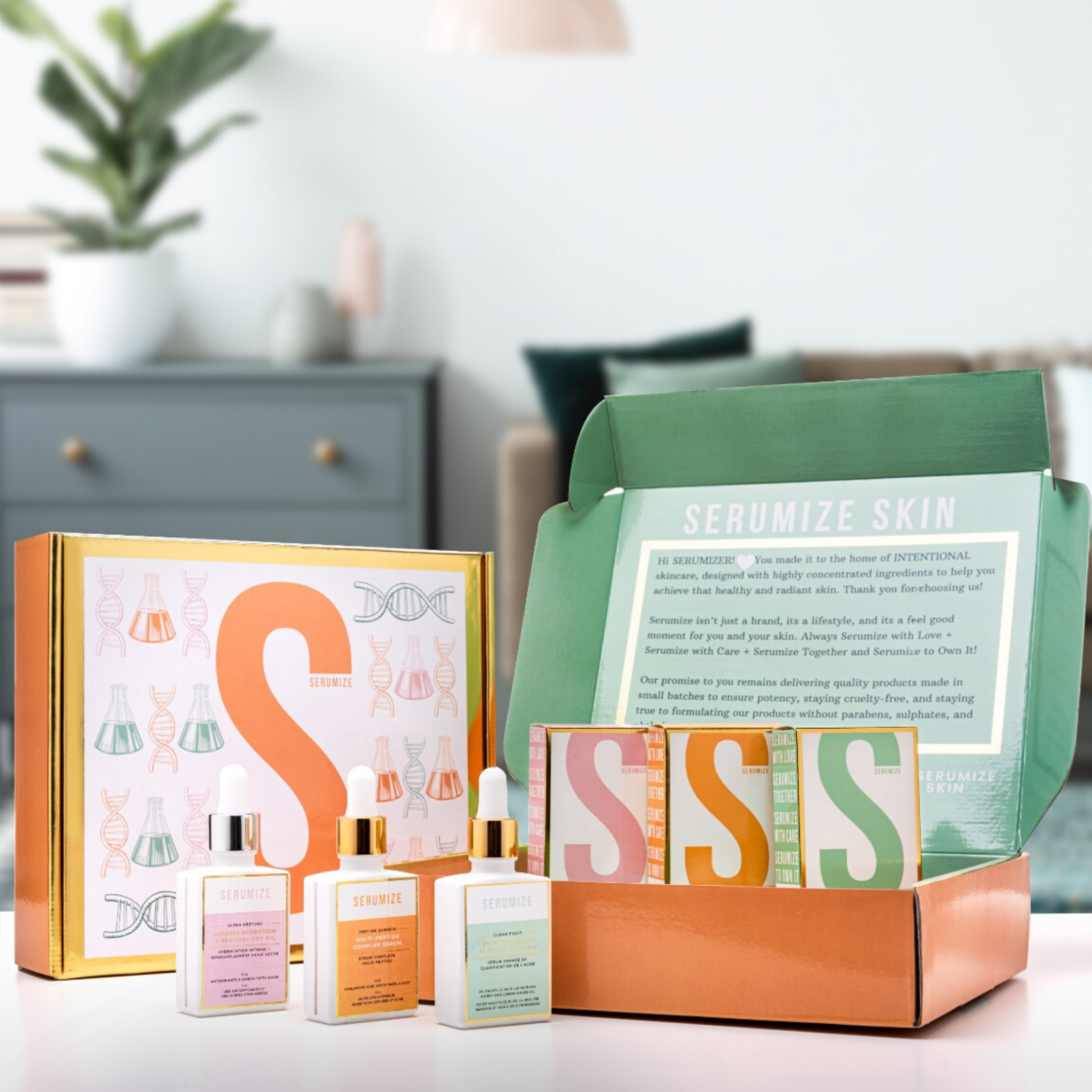
The SERUMIZE Ultra Restore Oil is formulated to act as a physiological lipid replacement, meaning it delivers the fatty acid profile closest to what the stratum corneum would naturally produce under healthy conditions. In practice, we see TEWL rates normalize measurably faster when a well-formulated face oil is introduced in week three of recovery. It doesn't occlude or suffocate the skin. It gives the barrier the raw materials it needs to rebuild the lamellar structure that chronic exfoliation has disrupted.

Alongside it, the SERUMIZE Ultra Restore Cleanser does something that sounds simple but is clinically significant: it is packed with potent antioxidants to thoroughly remove dirt and impurities without disturbing the skin's natural moisture balance. Most cleansers, even gentle-marketed ones, raise the skin's surface pH above 6.0. That inhibits the enzyme activity responsible for natural desquamation and slows ceramide synthesis. We formulated this cleanser to preserve the acid mantle through every wash because recovery cannot happen if cleansing continues to disrupt it.

|
SERUMIZE CLINICAL RECOMMENDATION Ultra Restore Oil + Ultra Restore Cleanser Used together during the step-down protocol to restore lipid architecture and maintain acid mantle integrity through every cleanse. Fragrance-free. Clinically formulated. |
If Your Skin Has Stopped Responding the Way It Should
Over-exfoliation is reversible. But the recovery window is entirely dependent on removing the obstacle, which means the answer is not another product. It's a clear protocol and the patience to follow it without shortcuts.
If you recognise more than three of the seven signs above, your skin barrier needs targeted support before any active ingredients can work effectively. The routine below is where we'd start.
|
BUILD YOUR RECOVERY ROUTINE Ultra Restore Cleanser + Ultra Restore Oil See the Formula → serumize.com/ultra-restore |
References
All cited studies are peer-reviewed or published by recognised dermatology organisations. Summaries reflect the study's primary findings in plain language.
1. Elias PM, Choi EH. (2005). Interactions among stratum corneum defensive functions. Experimental Dermatology. Established that ceramide synthesis, barrier repair, and antimicrobial defence are interdependent, compromising one through over-exfoliation impairs all three simultaneously.
2. Darlenski R, Fluhr JW. (2012). Influence of skin type, race, sex, and anatomical region on skin surface pH. British Journal of Dermatology. Confirmed that alkaline pH shifts, including those induced by high-pH cleansers, directly inhibit the serine proteases responsible for normal epidermal turnover.
3. Proksch E, Brandner JM, Jensen JM. (2008). The skin: an indispensable barrier. Experimental Dermatology. Reviewed lamellar body secretion and the role of the lipid bilayer in maintaining transepidermal water loss below clinically significant thresholds.
4. Denda M, Sato J, Masuda Y, et al. (1998). Exposure to a dry environment enhances epidermal permeability barrier function. Journal of Investigative Dermatology. Found that barrier disruption without lipid replenishment significantly increases TEWL within 24 hours and compounds over repeated cycles.
5. Choi EH, Brown BE, Crumrine D, et al. (2005). Mechanisms by which psychologic stress alters cutaneous permeability barrier homeostasis. Journal of Investigative Dermatology. Documented how inflammatory cascades triggered by epidermal barrier disruption parallel those caused by psychophysiological stress underscoring the systemic nature of barrier compromise.
6. American Academy of Dermatology Association. (2022). How to safely exfoliate at home. AAD Patient Guidelines. Recommends a maximum of 1–2 exfoliation sessions per week for most skin types and explicitly cautions against simultaneous use of multiple exfoliating agents.
7. Ramos-e-Silva M, Celem LR, Ramos-e-Silva S, et al. (2010). Anti-aging cosmetics: myths or reality? Clinics in Dermatology. Reviewed the evidence for acid-based exfoliants in skin renewal and found that frequency, concentration, and recovery interval are the primary determinants of outcome not product potency alone.