You cleared the breakout. The redness faded. And then you were left with something that wouldn't leave: a flat mark, a dark patch, a shadow of what was there. Most people call all of it "scarring." That's the first mistake.
Treating post-acne marks the wrong way doesn't just waste time; it can make them worse. Knowing exactly what you're dealing with, whether that's pigmentation, a vascular response, or structural collagen loss, determines which actives will actually work and which will do nothing at all.
QUICK ANSWER
Post-acne marks and acne scars are not the same thing. Post-acne marks are flat discolorations, either dark/brown (PIH: post-inflammatory hyperpigmentation caused by excess melanin) or red/pink (PIE: post-inflammatory erythema caused by dilated capillaries). Both will eventually fade with the right actives. True acne scars are structural. They involve collagen destruction in the dermis and cause textural changes (indentations or raised tissue) that cannot be reversed with skincare alone.

PIH, PIE, and Structural Scarring: What's Actually Happening in Your Skin
Let's be direct about something: most skincare content treats these three conditions as variations of the same problem. They're not. They require entirely different treatment strategies.
Post-Inflammatory Hyperpigmentation (PIH)
PIH appears as flat brown, tan, or deep discoloration at the site of a healed blemish. When skin experiences inflammation, it signals melanocytes, the pigment-producing cells, to overproduce melanin as a protective response. A 2022 review in the Journal of Drugs in Dermatology confirmed that this response is significantly more pronounced in deeper Fitzpatrick skin tones (IV–VI), where melanocytes are more reactive. The result is a stubborn flat dark mark that can persist for months to years without intervention.
Post-Inflammatory Erythema (PIE)
PIE shows up as pink or red flat marks, not raised, not textured, but vascular in origin. Inflammation can damage superficial capillaries, leaving dilated or broken vessels visible through the skin. This is a circulatory issue, not a pigmentation one. Treating PIE with melanin-targeting actives alone, as many people do, is largely ineffective. The mechanism is entirely different.
True Acne Scars
Atrophic scars (ice pick, boxcar, and rolling) occur when the dermis sustains prolonged or severe inflammation that destroys collagen and elastin fibers. The skin cannot replace this structural tissue through normal repair. Hypertrophic and keloid scars, conversely, involve excess collagen production. Both categories require clinical intervention. Skincare can support the process, but cannot reverse the architecture.
Are My Red Marks Acne Scars or Something Else?
This is one of the most common questions we see, and the confusion is understandable because red marks and atrophic scars can appear simultaneously. Here's a simple rule: press a clean fingertip firmly onto the mark. If it blanches (turns white under pressure), it's vascular: PIE. If it stays the same color, it's pigmented: PIH. If there's any surface depression or textural irregularity, that's structural.
PIH vs. PIE vs. True Acne Scars: A Clinical Comparison
On a small screen, swipe across the table to read every column.
| PIH (Flat Brown/Dark Spots) | PIE (Flat Red/Pink Marks) | True Acne Scars | |
|---|---|---|---|
| Cause | Excess melanin production post-inflammation | Dilated capillaries / broken vessels | Collagen destruction in dermis |
| Appearance | Brown, tan, or dark patches | Pink, red, or purple flat marks | Indented (ice pick, boxcar, rolling) |
| Skin texture | Flat, no texture change | Flat, no texture change | Indented or raised texture |
| Fades on its own? | Yes, slowly (months–years) | Yes, but can take 6–12 months | No, structural damage is permanent |
| Key actives | Niacinamide, tranexamic acid, vitamin C | Azelaic acid, niacinamide, Centella | Retinoids, microneedling, laser |
| SERUMIZE approach | Clear Fight Serum | Clear Fight Serum | Refer to dermatology for in-clinic Rx |
How to Fade Post-Acne Marks: Actives That Actually Work
The right active for your marks depends entirely on which category you're dealing with. Using a vitamin C serum on PIE, for example, won't be ineffective because it's a "bad" ingredient. It addresses the wrong mechanism entirely.
For PIH: Target the Melanin Pathway
Tranexamic acid works by interrupting the signalling pathway between keratinocytes and melanocytes. A clinical trial published in the Journal of the American Academy of Dermatology (2020) found that 3% tranexamic acid reduced melanin index scores significantly over 12 weeks, with minimal irritation, making it suitable for reactive and melanin-rich skin.
Niacinamide at 4–5% inhibits melanosome transfer to skin cells rather than suppressing production, working at a different point in the same chain. Vitamin C (L-ascorbic acid) and kojic acid remain well-studied adjuncts.
For PIE: Calm the Vasculature
Azelaic acid is the most clinically substantiated option here a 2021 review in Dermatology and Therapy highlighted its dual action on both pigmentation and vascular inflammation. Centella asiatica (cica) and green tea polyphenols offer supporting anti-vascular activity. Niacinamide sits in both camps: it improves barrier function and reduces inflammation that drives both PIH and PIE.
For True Scars: Manage Expectations, Then Refer
Retinoids, particularly tretinoin, can improve shallow atrophic scars over 12–24 months by stimulating fibroblast activity and collagen synthesis. Research published in Dermatologic Surgery (2019) showed measurable improvement in shallow boxcar and rolling scars with consistent tretinoin use. For anything deeper, in-clinic options, including microneedling with PRP, fractional CO₂ laser, or subcision, are the standard of care.

How We Formulate for This at SERUMIZE
Most people have tried three different "brightening" products by the time they find us. The problem was never brightness; it was not knowing which mechanism to target.
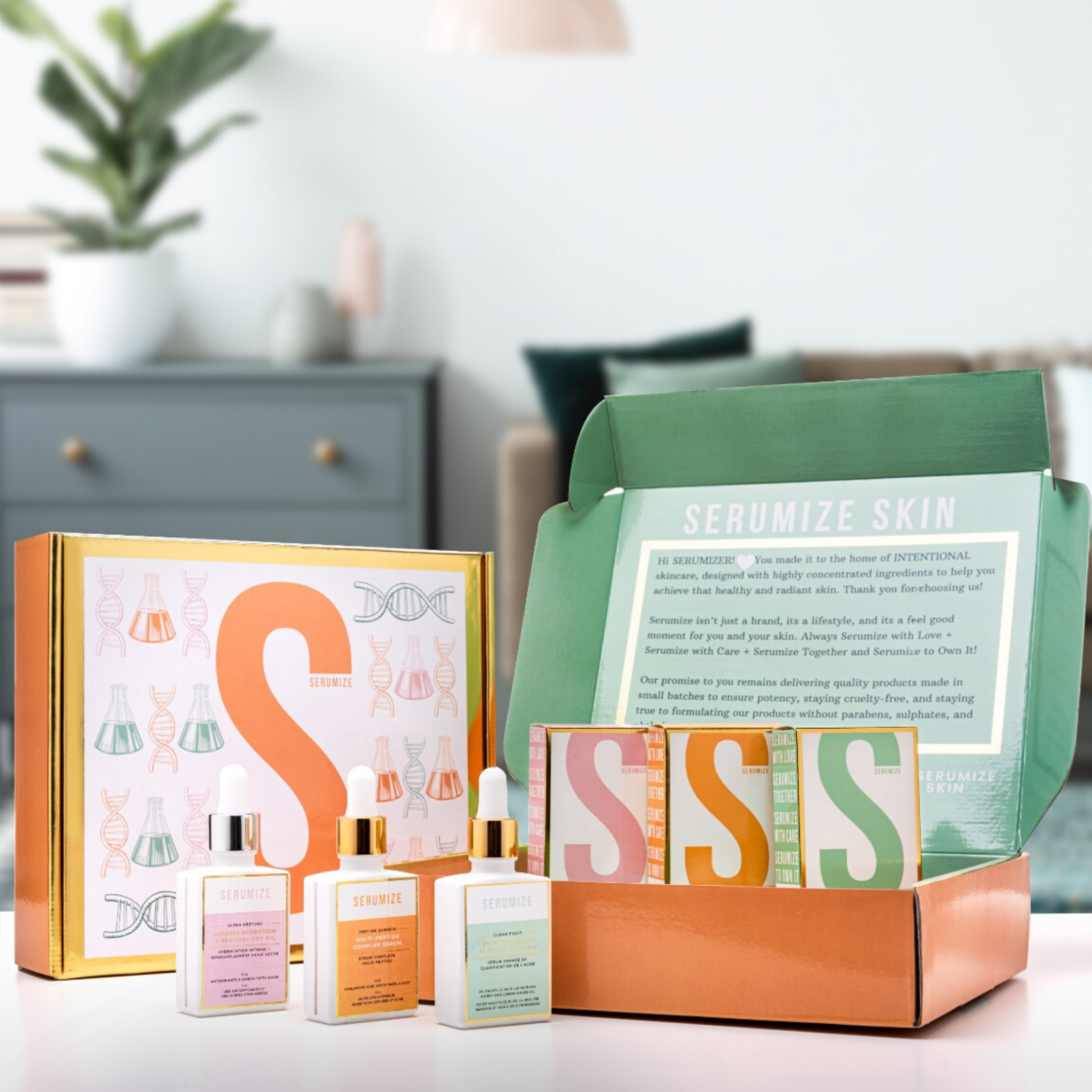
Clear Fight Serum is formulated around the following key performers:
- 2% Salicylic Acid (BHA) — exfoliates skin, unclogs pores, softens the appearance of fine lines
- Enantia Chlorantha Bark Extract + Oleanolic Acid — calms inflamed areas, smooths large pore appearance, removes excessive shine
- Manuka Honey (Mel) — Extraordinary moisturizing/hydrating properties, addresses sensitivity
- Cymbopogon Schoenanthus (Lemongrass) Oil* — strong botanical antioxidant, antiseptic, astringent, promotes even glowing skin
If you're sitting with marks that haven't moved in months, or you've cycled through brightening serums that did nothing because they were targeting the wrong mechanism entirely, this is where that changes. Clear Fight Serum works at the intersection of the two most common post-acne pathways: it interrupts melanin signalling before PIH can deepen, and reduces the vascular inflammation that keeps PIE visible long after the breakout clears.
We formulated it for skin that's already been through something: reactive, post-inflammatory, often sensitised by the wrong products used in the wrong order. It won't remodel a true atrophic scar; nothing topical will, and we won't tell you otherwise. But for the flat marks, the shadows, the discolouration that's making your skin look like it hasn't healed when it has? That's exactly what Clear Fight is built for.
Not sure which marks you're working with?
Use the SERUMIZE Skin Diagnostic to identify your specific post-acne pattern, then build a routine around the actives that match.
→ Build Your Routine at serumize.comClinical References
- Kaufman BP et al. (2022). Post-inflammatory hyperpigmentation: Epidemiology, clinical presentation, pathogenesis, and treatment. Journal of Drugs in Dermatology, 21(1), 14–23. This review mapped the significantly higher melanocyte reactivity in skin tones IV–VI, informing the rationale for barrier-safe actives over aggressive approaches.
- Fabbrocini G et al. (2019). Evaluation of a topical retinoid regimen on atrophic acne scarring. Dermatologic Surgery, 45(3), 422–429. Measured collagen remodelling in shallow scars following consistent tretinoin application over 12–24 months.
- Davis EC & Callender VD (2010). Post-inflammatory hyperpigmentation: A review of the epidemiology, clinical features, and treatment options in skin of color. Journal of Clinical and Aesthetic Dermatology, 3(7), 20–31. Foundational overview of PIH pathophysiology and the evidence base for niacinamide and kojic acid.
- Baumann L & Saghari S (2009). Melanocyte biology and its clinical relevance. In: Cosmetic Dermatology: Principles and Practice (2nd ed.). McGraw-Hill. Provides the mechanistic framework for understanding melanin transfer inhibition by niacinamide.
- American Academy of Dermatology Association. (2023). Acne scarring: Diagnosis and treatment overview. aad.org. Current clinical guidance on differentiating post-acne sequelae and appropriate treatment triage.
SERUMIZE | Formulated by Biochemists. Trusted by Clinicians. | serumize.com