|
QUICK ANSWER What causes skin texture on the face? Skin texture is caused by four distinct mechanisms: (1) keratin plug buildup in follicles, (2) subclinical congestion from excess sebum and desquamated cells, (3) dehydration-induced surface roughness from impaired barrier function, and (4) post-inflammatory hyperpigmentation (PIH) that creates uneven topographic changes. These often coexist. Effective treatment requires identifying and addressing each mechanism, a single active ingredient will not resolve all four. |
You've stood in front of a mirror, the kind of light that reveals everything, and wondered why your skin still looks rough. You cleanse. You moisturize. You've cycled through serums. The texture is still there. Most people have tried three different cleansers by the time they find us. The problem was never the cleanser.
Skin texture isn't one thing. It's four biologically distinct problems that frequently coexist, and collapsing them into a single complaint is precisely why most treatment attempts stall. A blanket "exfoliate more" recommendation will address one cause, aggravate another, and leave the remaining two entirely untouched.

The 4 Real Causes of Skin Texture (And Why Most Routines Only Address One)
Understanding what's actually happening at a structural level changes how you approach treatment. These aren't categories we invented; they map directly to peer-reviewed mechanisms in dermatological literature.
1. Keratin Plug Buildup
Keratin is a structural protein. Under normal conditions, dead keratinocytes shed continuously in a process called desquamation. When this is disrupted by sebum overproduction, friction, or certain occlusive products, keratin accumulates in the follicular canal, creating the characteristic rough, sandpaper feel most people associate with "texture."
A 2018 review published in the Journal of the European Academy of Dermatology and Venereology found that BHA (beta-hydroxy acid), specifically salicylic acid, is uniquely effective here because it is oil-soluble, allowing it to penetrate the lipid-rich follicular environment and break the bonds holding keratin plugs together. Water-soluble AHAs cannot reach this substrate.
2. Subclinical Congestion
This is the texture that doesn't look like breakouts but never quite resolves. Subclinical congestion sits beneath the surface, a low-grade accumulation of sebum and non-desquamated cells that hasn't yet become a visible comedone. It creates a matte, uneven topography that makeup can't cover, and moisturizer can't fix.
Niacinamide (vitamin B3) addresses this through two validated mechanisms: it significantly reduces sebocyte lipid production (demonstrated in a controlled study published in the Journal of Cosmetic Dermatology, 2017), and it reinforces barrier integrity, which matters because a compromised barrier accelerates the buildup cycle.
3. Dehydration-Induced Surface Roughness
Forget oil. Dehydrated skin and dry skin are different diagnoses with different treatments. Dehydration is a transient water deficit in the stratum corneum (the outermost skin layer) caused by impaired barrier function. The skin surface loses its smooth reflectivity and develops a crepey, tight texture that worsens under makeup.
A compromised skin barrier (quantified by elevated transepidermal water loss, or TEWL) is the underlying mechanism, not a lack of drinking water. Ceramide-containing formulas restore the intercellular lipid matrix. Hyaluronic acid, particularly low-molecular-weight variants that penetrate to deeper epidermal layers, provides meaningful, measurable hydration density.
4. Post-Inflammatory Texture (PIH and Structural Changes)
This is the one most people don't recognize as texture. After any inflammatory event, a blemish, a reaction, even chronic low-grade redness, the skin heals imperfectly. Melanin deposits create color-based unevenness, but the surface also changes: dermal remodeling alters collagen architecture, producing both raised and depressed irregularities. You're not imagining it. The skin is structurally different in those areas. Vitamin C (L-ascorbic acid at clinically active concentrations) inhibits tyrosinase, the enzyme central to melanin synthesis, while simultaneously acting as an antioxidant to interrupt the oxidative cascade that deepens post-inflammatory discoloration. Tranexamic acid offers a complementary pathway, blocking plasmin-mediated melanocyte activation.
Which Active Ingredient Targets Which Texture Type?
This is where most routines go wrong: they apply the same active to every kind of texture. The table below maps each cause to the mechanism that resolves it.
|
CAUSE |
KEY ACTIVE(S) |
MECHANISM |
SKIN SIGN |
|
Keratin Plugs |
BHA (salicylic acid) |
Dissolves within the follicle; breaks keratin bonds |
Light, rough bumps; visible pores |
|
Congestion |
Niacinamide + AHA (glycolic/lactic) |
Regulates sebum; resurfaces dead cell layer |
Comedones: dull, uneven finish |
|
Dehydration Roughness |
Hyaluronic acid + ceramides |
Restores barrier; replenishes water binding |
Tight, flaky, crepey feel |
|
PIH Texture |
Vitamin C + tranexamic acid |
Inhibits melanin synthesis; antioxidant protection |
Dark patches with a raised or depressed surface |
"Why is my skin texture so bad even though I have a skincare routine?"
This is the most common question we hear. The answer is almost always sequencing. A routine that applies actives in the wrong order or uses concentrations too low to drive real change will feel like it's working without producing clinical results. Niacinamide at 2% is cosmetically elegant. At 10%, it has documented sebum-regulating efficacy. These are not the same product. Layering an AHA over an unrepaired barrier is another common error. The acid resurfaces effectively, but the exposed skin loses water faster than it can be replaced, and the dehydrated texture worsens. The fix isn't to stop exfoliating; it's to restore barrier function first, then introduce resurfacing actives.
 A Clinical Recommendation: What We Use for Multi-Cause Texture
When texture has more than one cause, which, in our clinical experience, it almost always does, the goal is a protocol that works through multiple mechanisms without overwhelming the skin's ability to adapt.
|
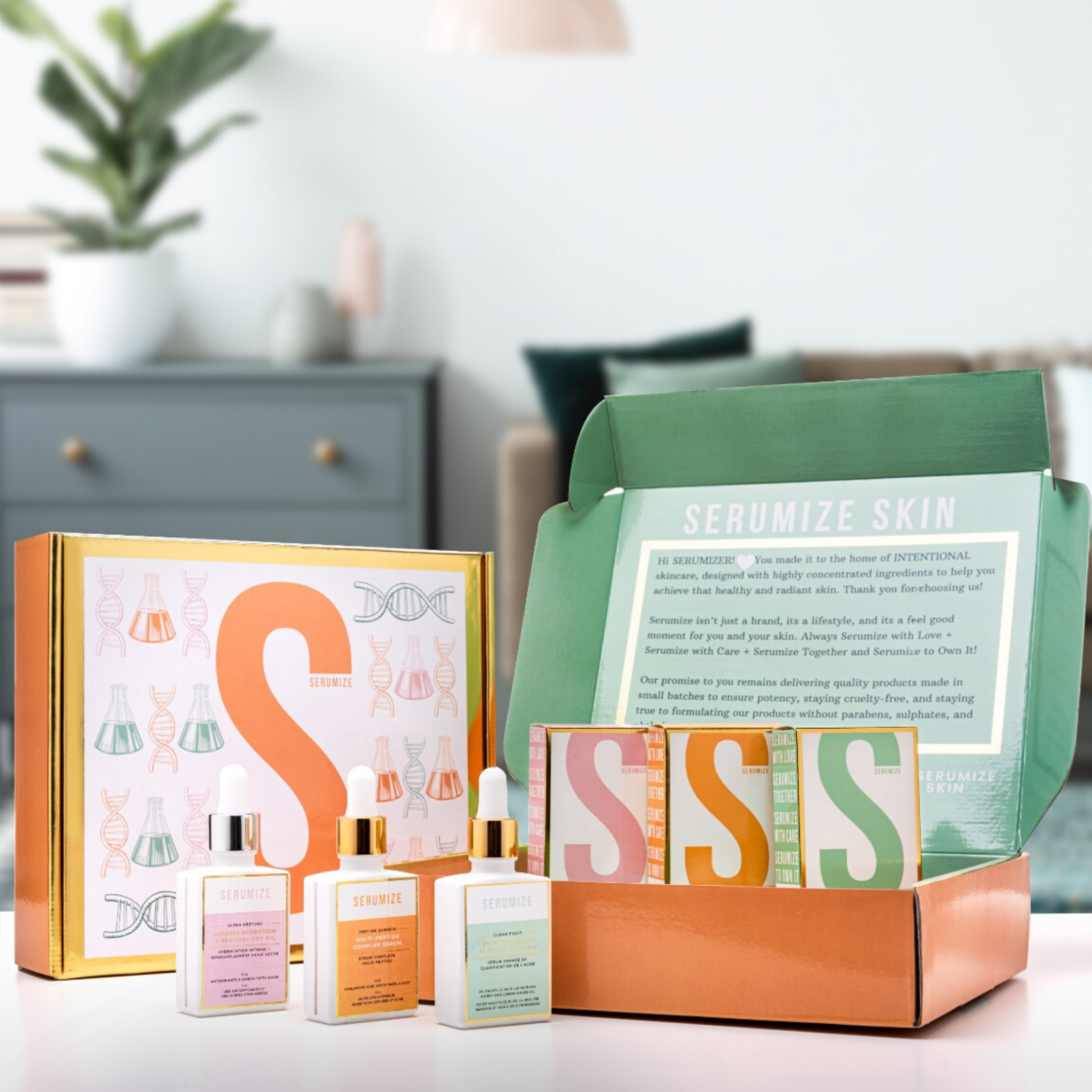
CLINICAL RECOMMENDATION SERUMIZE Clear Fight Serum works at the follicular and epidermal level simultaneously. Its formulation drives sebum regulation, while BHA exfoliates the skin, unclogs pores, and softens the appearance of fine lines. The result isn't surface-level smoothing, but a structural correction of the environment that generates texture in the first place.
For texture with a dehydration or PIH component, Clear Fight Serum integrates most effectively when paired with a barrier-support formulation at night and a stabilized vitamin C in the morning. Each addresses a distinct cause; none of them overlap. |
We formulate every SERUMIZE product around a single question: what does this molecule actually do at the cellular level, and at what concentration does it cross from cosmetic to clinically meaningful? Clear Fight Serum didn't begin as a concept. It began as a formula built backwards from the mechanisms of texture, not forwards from a marketing brief.
|
SERUMIZE Build Your Routine Around Your Texture Type You came here because your skin isn't responding to what you've tried. That's the most useful information we have. Use the routine builder to map your texture type to the right actives, in the right order, at the right concentration.
→ See the Formula | Build Your Routine | Find Your Protocol |
References
1. Fluhr JW, et al. (2018). "Keratinocyte desquamation and skin barrier dysfunction." J Eur Acad Dermatol Venereol. 32(3):380–390. Found that disrupted cornification is a primary driver of follicular texture, with BHA specifically penetrating follicular lipids.
2. Rawlings AV, Harding CR. (2004). "Moisturization and skin barrier function." Dermatol Ther. 17(Suppl 1):43–48. Established ceramide depletion as the primary mechanism of elevated TEWL and dehydration-related texture.
3. Telang PS. (2013). "Vitamin C in dermatology." Indian Dermatol Online J. 4(2):143–146. Detailed the dual action of ascorbic acid on tyrosinase inhibition and post-inflammatory oxidative pathways.
4. Sheth VM, Pandya AG. (2011). "Melasma: a comprehensive update, Part I." J Am Acad Dermatol. 65(4):689–697. Documented plasmin-mediated melanocyte activation as the biochemical pathway tranexamic acid interrupts.
5. American Academy of Dermatology Association. (2023). "Skin Care on a Budget." aad.org. Endorses barrier repair as a prerequisite to effective resurfacing in routine design.
6. Kornhauser A, et al. (2010). "Applications of hydroxy acids: classification, mechanisms, and photoactivity." Clin Cosmet Investig Dermatol. 3:135–142. Compared AHA and BHA solubility profiles, confirming that lipophilicity determines follicular penetration depth.
7. Baumann L. (2009). Cosmetic Dermatology: Principles and Practice (2nd ed.). McGraw-Hill. Core reference for subclinical congestion classification and comedogenesis pathways.
SERUMIZE · Formulated by a biochemist and medical esthetician · serumize.com