Three weeks into a new active ingredient, your skin looks worse, not better. You're standing in front of the mirror deciding whether to throw out a product that cost you good money. We get some version of this question more than almost any other one in clinic. The answer changes what you do next: keep going, or start over.
|
Quick Answer • Purging: small, non-inflamed bumps (whiteheads, blackheads) in the areas you already break out, appearing within 2–4 weeks of starting a new active, and clearing within 4–6 weeks of continued use. • Breakout or reaction: new lesion types: papules, cysts, or a rash, showing up in new areas, and getting worse rather than better over time. • Rule of thumb: if it isn't visibly improving by week six, it isn't purging. |

Purging Isn't Your Skin “Detoxing”
Purging sounds like your skin releasing something it's been storing. It isn't. There's no detox mechanism sitting in the epidermis, waiting for a serum to unlock it. What's actually happening is mechanical: keratinocytes normally travel from the basal layer to the skin's surface over roughly 28 days, and ingredients like retinoids and hydroxy acids compress that cycle to about 2 weeks by increasing keratinocyte proliferation and turnover1,2. That faster cycle pulls microcomedones, the clogged, invisible precursors to acne that were already forming under the surface, up faster than they'd have arrived on their own. We formulate around this mechanism constantly, and the pattern holds: purging is acceleration, not reaction.
“Is This Purging or Am I Breaking Out?”
This is the question we hear most, close to word for word, usually around week three. The honest answer comes down to three things: where the bumps are, what kind they are, and which direction the pattern is moving.
|
Signal |
Purging |
Breakout / Reaction |
|
Location |
Same spots you always break out |
New areas, previously clear |
|
Lesion type |
Whiteheads, blackheads, small non-inflamed bumps |
Papules, cysts, pustules, or a rash |
|
Onset |
Within 2–4 weeks of starting the active |
Anytime, often immediate or random |
|
Trajectory |
Improves week over week after week 4 |
Stays the same or worsens |
|
Duration |
Resolves within 4–6 weeks |
Persists past 6 weeks |
How Long Does Purging Actually Last? The Six-Week Rule
Four to six weeks. That's roughly one compressed turnover cycle for most people on a standard-strength retinoid or acid, and it's the window we ask patients to commit to before they judge a product. A 2024 clinical practice guideline on acne treatment describes topical retinoids as the foundation of therapy precisely because their benefit builds over weeks rather than days3, pulling a product at week two interrupts the cycle before it finishes. Some people need eight to twelve weeks, particularly with more congestion to clear or naturally slower turnover. Past that point, with no change in the same spots, it stops being purging.
When It's Not Purging
|
Stop and reassess if you notice: • Burning or stinging that doesn't fade within an hour of application • Spreading redness, hives, or swelling • Blistering or broken skin • Symptoms still escalating past the six-week mark These point to irritant or allergic contact dermatitis, not accelerated turnover. No amount of patience fixes a genuine reaction. That calls for stopping the product and, if it doesn't settle quickly, a dermatologist.4 |
 What We Recommend While Your Skin Recalibrates
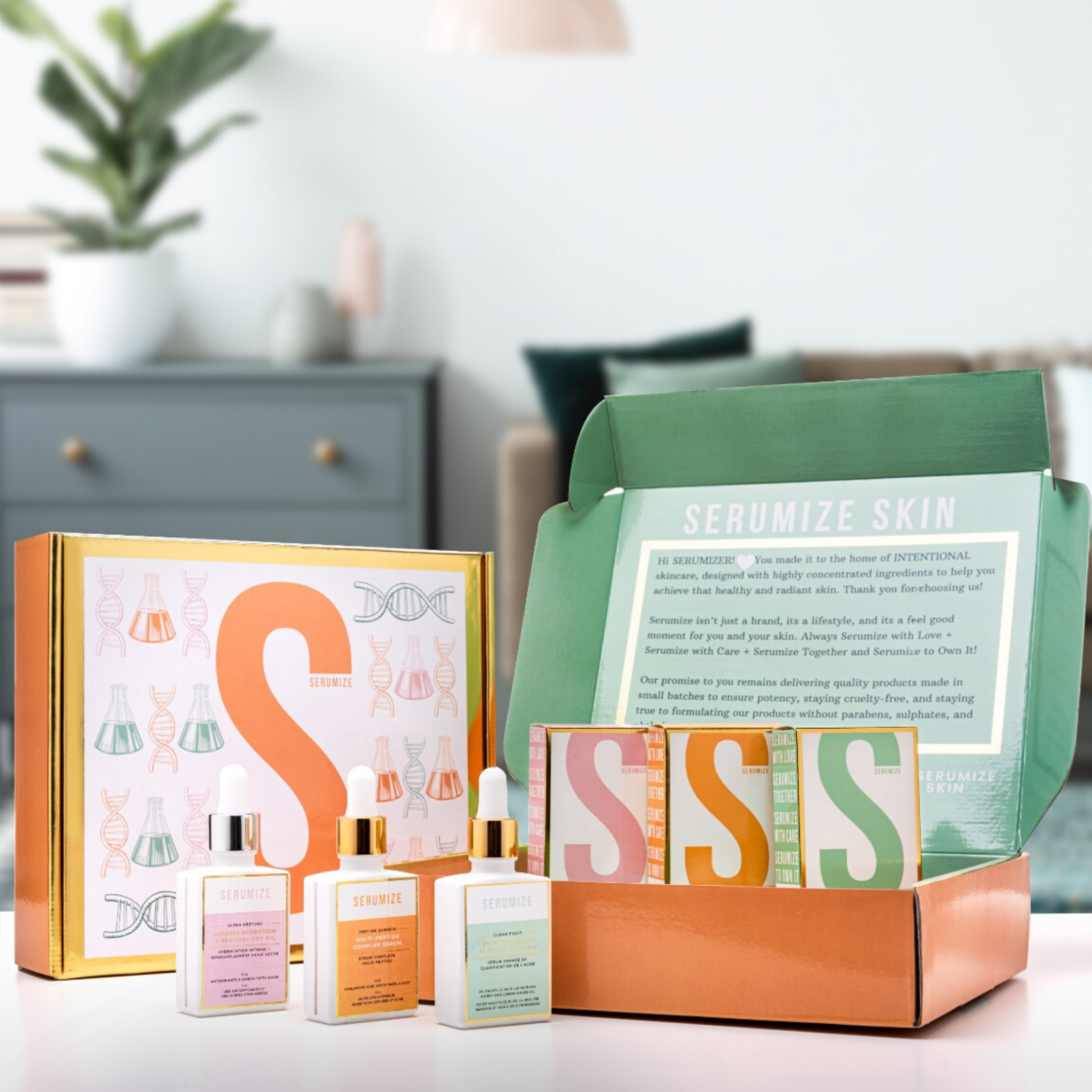
Most people have already tried two or three products by the time they land here, each one abandoned right as it started working. The problem was rarely the product. It was the timeline. During an active purge, the priority is protecting the barrier while turnover does its work, not adding more exfoliation on top of it. This is where we point patients to Clear Fight Serum: it targets congestion at the follicle level and helps regulate sebum output, calming the inflammatory response that makes a purge feel worse than it is. The goal isn't to speed up the purge. It's to keep the barrier intact while it runs its course.
|
If you're mid-purge right now and weighing whether to stop, that decision doesn't have to be a guess. Bring us the pattern: where, what kind, how long, and we'll tell you whether you're weeks from clear or dealing with something else entirely. Find Your Routine → |
Sources
1. Zasada, M., & Budzisz, E. (2019). Retinoids: active molecules influencing skin structure formation in cosmetic and dermatological treatments. Postępy Dermatologii i Alergologii, 36(4), 392–397.
2. Next Steps in Dermatology. All Things Retinol: mechanism of action and keratinocyte turnover.
3. American Academy of Dermatology / Journal of the American Academy of Dermatology. Guidelines of Care for the Management of Acne Vulgaris (2024).
4. Medical News Today (medically reviewed). Skin Purging: Pictures, Causes, and Treatments.
5. Forbat, E., Al-Niaimi, F., & Ali, F. R. (2017). Use of nicotinamide in dermatology. Clinical and Experimental Dermatology, 42(2), 137–144.
6. Draelos, Z. D., Matsubara, A., & Smiles, K. (2006). The effect of 2% niacinamide on facial sebum production. Journal of Cosmetic and Laser Therapy, 8(2), 96–101.