You flip the bottle over and fifteen words in, you hit Butyrospermum Parkii and stop reading. That is not a failure of intelligence. It is a failure of translation. Ingredient labels are written in a regulatory language, not a marketing one, and nobody taught you the grammar. We formulate against that gap every day, and the questions we get most often are not about which product to buy. They are about what the label in front of them actually says. The problem was rarely the serum. It was that nobody could tell them what was in it, or why it mattered.

QUICK ANSWER
Skincare ingredients are listed by INCI name in descending order of concentration, down to 1%. Below that threshold, brands can list ingredients in any sequence, so order stops being informative near the bottom of the list. "Fragrance" or "parfum" is a legal umbrella term that can legally conceal dozens of undisclosed compounds. To read a label fast: check the first five ingredients, since they make up the bulk of the formula; locate your target active and note whether it sits above or below the 1% cutoff; and treat the word "fragrance" as a variable, not a fact.
What Is An INCI Name, And Why Does It Look Like Latin?
INCI stands for International Nomenclature of Cosmetic Ingredients. It is a single naming standard that lets a formulator in Seoul, a regulator in Brussels, and a dermatologist in Chicago read the exact same label and mean the exact same thing.
Plant-derived ingredients get their botanical Latin name. Shea butter becomes Butyrospermum Parkii. Mineral or synthetic compounds get their chemical name instead, which is why a label can swing from Latin to chemistry mid-sentence. Neither naming convention is a red flag on its own. It is simply the taxonomy.
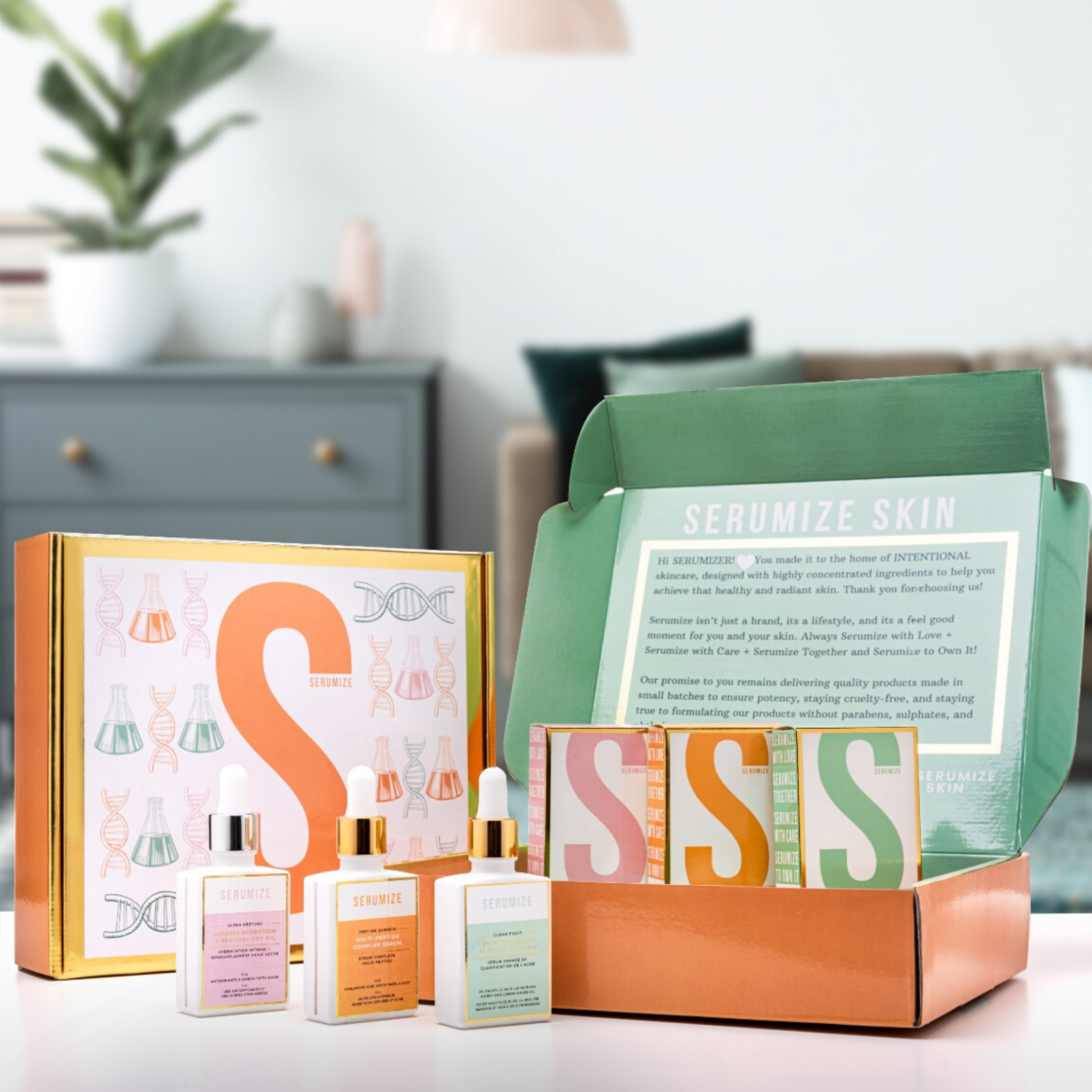
We use INCI names on every SERUMIZE label for this exact reason. It is the one naming system a chemist, a regulator, and a discerning reader can all verify independently, without relying on whatever a brand chooses to call something on the front of the box.
Why Are Skincare Ingredients Listed In That Order?
Here is what most people get wrong: they assume the entire list is ranked strictly by amount, top to bottom. It isn't. Under both FDA and EU cosmetic labeling rules, ingredients present at 1% or higher must be listed in descending order of concentration. Once a formula drops below that 1% threshold, order becomes discretionary; a brand can sequence the remaining ingredients however it likes. This is why water, glycerin, or a base emollient almost always appears first. It is the vehicle, not the value. The active you actually bought the product for might sit fourth on the list or sixteenth, and both positions can be therapeutically meaningful, depending on what that ingredient needs to work.
Is Fragrance In Skincare Bad For You
Sometimes. "Fragrance" and "parfum" are legal umbrella terms, and a single line item can represent a proprietary blend of dozens of individual compounds that the brand is not required to itemize. The EU addresses part of this by requiring disclosure of 26 specific fragrance allergens when they exceed a set threshold, which is why you sometimes see linalool or limonene listed separately, right next to the word fragrance itself. In the US, no equivalent disclosure requirement exists.
For most skin, this is a non-issue. But for reactive or sensitized skin, fragrance remains one of the more common triggers of allergic contact dermatitis from cosmetics, which is reason enough to patch test anything with an undisclosed scent blend before it goes on your face for a week straight.

The Marketing Words That Mean Nothing On A Label
None of these words appear on the ingredient list itself. They appear on the front of the box, which is exactly why they are worth separating from what the back of the box can actually prove.
On a small screen, swipe across the table to read every column.
| Marketing Term | What It Actually Means |
|---|---|
| "Clean" | No regulated legal definition. Meaning is set entirely by the brand using it. |
| "Natural" | Describes botanical origin only. It says nothing about safety, purity, or concentration. |
| "Dermatologist Tested" | Confirms a test occurred. Does not disclose sample size, outcome, or pass criteria. |
| "Hypoallergenic" | No FDA-mandated testing standard exists behind this claim in the US. |
Red Flags Worth A Second Look
Not every long name is dangerous, and not every short one is safe. A handful of patterns are worth actually pausing on. Denatured alcohol is high on the list, especially on skin that is already compromised. Essential oils clustered near the top rather than the bottom of a formula, since their concentration correlates directly with irritation risk. And any active ingredient advertised on the front of the box that never appears with a percentage anywhere on the label, because brands are not required to disclose active concentrations at all.
That last gap is one we built into how SERUMIZE publishes formulas. Every product page lists the working concentration of its key active alongside the standard INCI list, not because regulation requires it, but because label literacy should not stop at the legal minimum.

Read The Label, Then Build The Routine
Once a label stops being a wall of unpronounceable words, the next question gets a lot simpler: does this formula actually match what your skin needs, at a concentration that can do something?
That is a formula question, not a willpower question. It starts with the label you now know how to read.
Sources
-
Personal Care Products Council — International Nomenclature of Cosmetic Ingredients (INCI) Dictionary.
Establishes the single naming standard used on cosmetic labels worldwide, which is why the same ingredient reads identically across brands and countries.
-
U.S. Food and Drug Administration — 21 CFR § 701.3, Cosmetic Labeling: Ingredient Declaration.
Requires ingredients at or above 1% concentration to be listed in descending order; ingredients below that threshold may be listed in any order.
-
European Commission — Regulation (EC) No 1223/2009 on Cosmetic Products, Annex III.
Mandates on-label disclosure of 26 specific fragrance allergens once they exceed a defined concentration threshold.
-
American Academy of Dermatology — patient resource on fragrance allergy.
Identifies fragrance as among the most frequent causes of allergic contact dermatitis linked to personal care products.
-
de Groot, A.C., et al. — Contact Dermatitis (peer-reviewed journal), fragrance-mix sensitization studies.
Patch-testing research documenting measurable sensitization rates to common fragrance-mix components across tested populations.
-
Cosmetic Ingredient Review (CIR) Expert Panel — safety assessments of cosmetic preservatives.
Independent panel review of existing toxicology data that sets recommended maximum use concentrations for ingredients like phenoxyethanol.
-
Journal of Cosmetic Dermatology — research on active-ingredient concentration thresholds for measurable efficacy.
Demonstrates that many actives require a specific minimum percentage to produce a clinically measurable effect, a figure most labels do not disclose.