The moisturizer that kept your skin balanced in July can leave it tight, flaking, and reactive by the second week of October. That's not your skin overreacting. It's biology.
Relative humidity drops, indoor heating switches on, and the barrier that handled a summer of sweat and sebum without complaint suddenly can't hold water the way it did eight weeks ago. Most people respond by adding more product on top of a routine that's already failing. We see this every year, and it's almost always the wrong move.
|
QUICK ANSWER Fall skincare routine changes come down to four adjustments: switch from a foaming or gel cleanser to a cream cleanser, reduce exfoliation frequency, add lipid-replenishing ingredients (ceramides, fatty acids, peptides), and layer a richer occlusive at night. The goal is offsetting the measurable rise in transepidermal water loss that occurs as ambient humidity drops, not adding more products on top of a routine that's already struggling. |
Why Fall Breaks Down A Summer Skincare Routine
Most people assume the problem is temperature. It isn't, not directly at least; humidity is the variable that actually matters. Research published in the Journal of the European Academy of Dermatology and Venereology found that skin barrier function is strongest when relative humidity sits between 40 and 60 percent; below that range, transepidermal water loss (TEWL) rises, and the stratum corneum begins to stiffen and crack.
A broader review of environmental effects on the skin reached a similar conclusion from a different angle: low humidity combined with lower temperature reduces barrier function and leaves skin measurably more reactive to friction, cleansing, and topical actives. That's the cleansing routine and the retinol you were using without issue all summer.
“Why does my skin get so dry when the weather changes”
Because the skin you're washing and treating today has a different lipid reserve than the skin you were treating in July. Interestingly, formal reviews of seasonal TEWL data are mixed; some show water loss is actually higher in summer, driven by heat rather than dryness. What that tells us clinically is that it's the transition itself, the whiplash between two stable states, that stresses the barrier more than either season alone. The moisturizer was rarely the actual problem. The ratio of humectant to occlusive in their routine was.

Should You Switch Cleansers For Fall?
If you're still using a foaming or gel cleanser built for a summer of excess oil, fall is when it starts fighting you instead of helping you. Foaming surfactants are formulated to strip lipids efficiently; genuinely useful in July, a liability once ambient humidity drops and skin has less oil to spare. We move most clients to a cream or lipid-based cleanser by mid-September. Not because gel cleansers are flawed. Because the environment they were built to solve for is gone.
What Happens To Retinoids And Acids In Fall
Retinoids and exfoliating acids don't become less effective in fall. They become harder to tolerate, and that's a barrier problem, not a product problem. Skin with reduced ceramide reserves (the default state of most skin by October) absorbs actives faster and buffers irritation more slowly, so the same 0.3% retinol that felt fine in August can trigger real inflammation by November.
Reintroducing Actives Without Losing The Barrier
Drop frequency before you drop the product entirely. Buffer with a lipid-rich layer underneath, not on top. Give the barrier one to two weeks of pure repair before asking it to tolerate exfoliation again. Rebuilding lipid reserves first is what makes the actives tolerable at all.
The Moisturizer Swap That Actually Matters
This is where lipid-rich formulas earn their place, and the clinical evidence for that is specific rather than vague. A randomized trial of a ceramide-dominant moisturizing cream found a sustained reduction in visible dry-skin signs and improved hydration within days of consistent use. More recent work published in the British Journal of Dermatology went further, showing that topical lipid supplementation doesn't just sit on the surface; it measurably rebalances the skin's own ceramide profile over time.
|
|
SUMMER FORMULA |
FALL FORMULA |
|
Texture |
Lightweight gel-cream |
Richer cream or facial oil layer |
|
Core function |
Sebum control, light hydration |
Lipid replenishment, barrier repair |
|
Key ingredients |
Niacinamide, light hyaluronic acid |
Ceramides, peptides, fatty acids, occlusive oils |
|
Exfoliation |
3–4x weekly, acids tolerated well |
1–2x weekly until barrier stabilizes |
|
Night layering |
Single serum, minimal occlusion |
Serum + oil, sealed with occlusive cream |

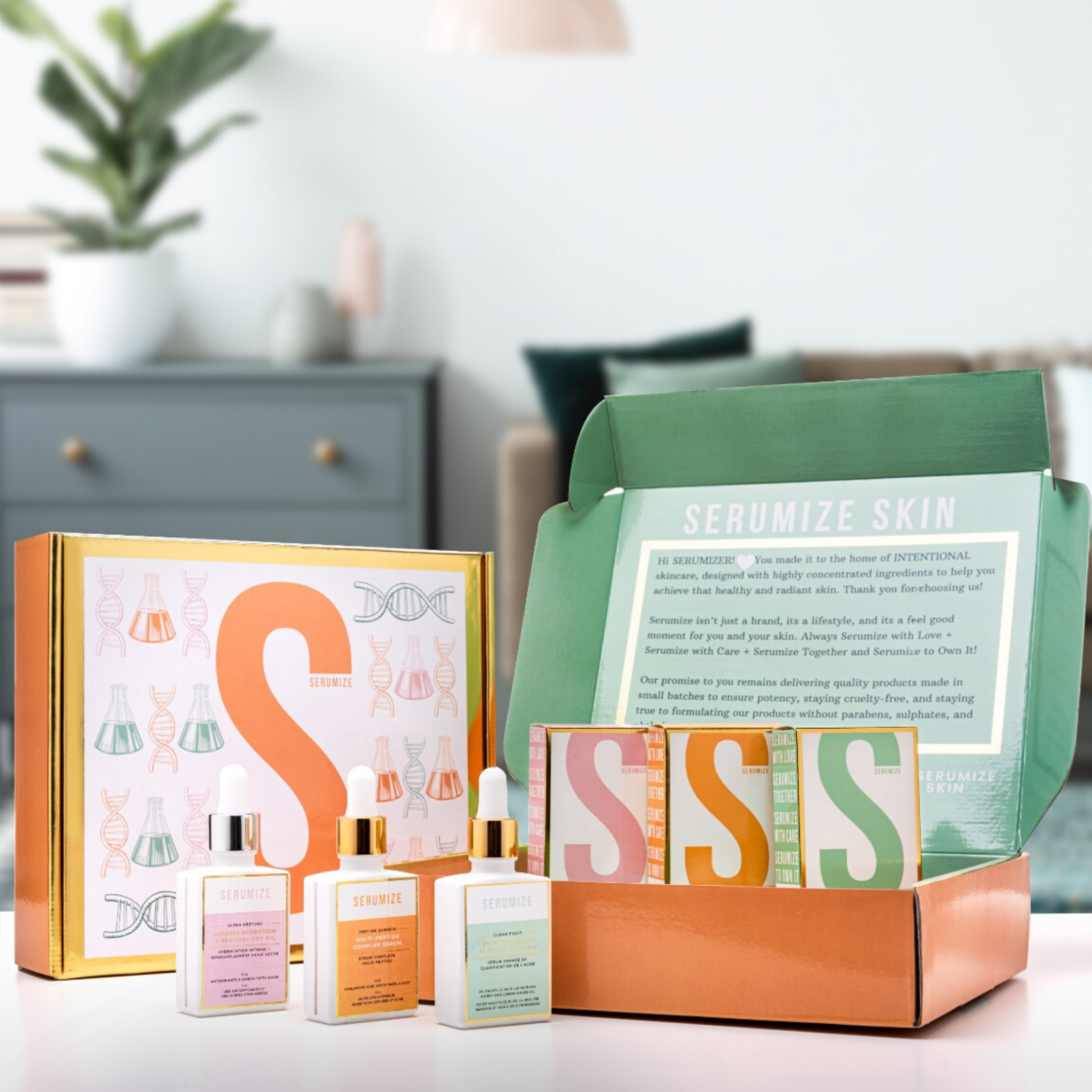
For skin moving out of a lightweight summer formula, we typically recommend layering in a peptide-supported facial oil at night, one that reinforces the intercellular lipid matrix while supporting the collagen-signaling work that UV exposure spent all summer undoing. That combination, the same mechanism behind our Ultra Restore Oil + Peptide Quench, is usually what's missing from an October routine. Not another serum. A layer that actually seals.

Don't Drop Your SPF
UV exposure doesn't take a season off. The American Academy of Dermatology has flagged that a notable share of adults reduce or stop sunscreen use once summer ends, unaware that ultraviolet rays remain present through fall and winter at levels that still contribute to visible aging and pigment change. Keep the SPF exactly where it is. Change everything happening around it.
Build A Routine For The Skin You Have Now
You didn't do anything wrong this summer. Your skin adapted to a specific set of conditions, and those conditions have changed underneath it. Fixing that isn't about buying more products; it's about correcting the ratio of hydration, lipid, and active ingredients you're already reaching for. If your skin has been telling you something's off for the last few weeks, this is what it's been trying to say.
|
BUILD YOUR ROUTINE → A guided fit for your fall barrier, not a guess. |
Sources
Goad, N. et al. “Ambient Humidity and the Skin.” Journal of the European Academy of Dermatology and Venereology, 2016. Found that skin barrier function is strongest within a 40–60% relative humidity range, and that TEWL and skin roughness both increase measurably once humidity drops below it.
Engebretsen, K.A. et al. “The Effect of Environmental Humidity and Temperature on Skin Barrier Function and Dermatitis.” Clinical and Experimental Dermatology. A review of the mechanistic literature concluding that low humidity paired with low temperature reduces barrier function and increases skin's reactivity to mechanical and chemical stress.
“Transepidermal Water Loss: Environment and Pollution — A Systematic Review.” PMC, National Library of Medicine. A systematic review of TEWL studies across seasons, noting that results are mixed and that some data show higher water loss in summer heat rather than fall or winter dryness.
Lueangarun, S. et al. “Ceramide-Containing Moisturizer Study.” Journal of Drugs in Dermatology. A randomized, investigator-blinded trial found that a ceramide-containing cream produced sustained improvements in hydration and a measurable reduction in visible dry-skin signs.
“Topical Supplementation With Physiological Lipids Rebalances the Stratum Corneum Ceramide Profile.” British Journal of Dermatology, 2025. Found that topical lipid application changes the skin's own ceramide composition over time, rather than simply coating the surface temporarily.
Denda, M. et al. “Abrupt Decreases in Environmental Humidity Induce Abnormalities in Permeability Barrier Homeostasis.” Journal of Investigative Dermatology. Experimental work showing that a sudden drop in environmental humidity — like the shift from summer to fall — disrupts the skin's barrier recovery process more than a stable dry environment does.
American Academy of Dermatology. “Cold Weather and Your Skin.” AAD public health guidance. AAD survey data cited a notable share of adults unknowingly reduce sun protection once summer ends, despite continued UV exposure through fall and winter.